 how-to
How to Find Homes With a Pool in Port Charlotte
Table of Contents
- Start Your Search: Using Port Charlotte Real Estate Search Filters
- Private Pool vs. Community Pool: What's the Difference?
- Pool Inspection Checklist for Home Buyers
- Questions to Ask When Buying a Home With a Pool
- Understanding Pool Maintenance Costs for Homeowners
- Review Listing Photos and Property Details
- Get Expert Help Finding Your Pool Home
- Frequently Asked Questions
Last Updated: October 17, 2026
Start Your Search: Using Port Charlotte Real Estate Search Filters
Most buyers lose time because they treat a listing site like a catalog instead of a search engine, but knowing how to find homes with a pool in port charlotte in Florida requires a repeatable workflow. Here is a repeatable workflow you can run on any major portal or a local MLS-fed IDX site.
Step 1: Build the base filter stack
Set filters in this order, because each one changes how many results the next can return:
- Location. Search by city first, then add ZIP codes one at a time, noting result counts. The pool-heavy ZIPs include 33948, 33952, 33953, 33954, and 33980.
- Property type. Select single-family. Pool homes are overwhelmingly detached houses; townhomes and condos usually offer community pool access rather than a private pool.
- Pool amenity. Check "Private Pool" if offered, otherwise check "Pool" and screen manually. Where sites separate "Private Pool" from "Community Pool," run two saved searches, the price bands differ.
- Price. Set a range, not a single number. Start about 10% below your ceiling so you can see what the next tier up looks like.
- Bed/bath and square footage. Add these last; they cut results fastest and can hide pool homes that are slightly smaller than your target.
Step 2: Save the search and turn on alerts
Save the search and enable daily or instant alerts, not weekly, pool homes in a desirable ZIP can go under contract within days. Name saved searches by ZIP and pool type (for example, "33952 private pool") to compare counts week over week.
Step 3: Screen the results for pool signals
A checked pool filter is a claim, not a confirmation. Scan each result for these signals before you spend time on it:
- The word "pool" in the listing remarks, not just the amenity checkbox
- At least two pool photos, including the equipment pad
- A stated pool type (in-ground, above-ground, saltwater, chlorine) and whether it is heated
- HOA fee and whether the pool is private or community
If the amenity box is checked but no photo or remark mentions a pool, treat it as unverified until the listing agent confirms.
Step 4: Refine with map and commute layers
Switch to map view, draw a boundary around the streets you want, and layer in what matters, schools, grocery, the nearest boat ramp, or drive time to work. Map view exposes patterns lists hide: pool homes often cluster on larger lots, and some streets have deed restrictions or HOA rules affecting pool enclosures and fencing.
Step 5: Verify before you tour
Before scheduling a showing, confirm with the listing agent: pool type, whether it is heated, equipment age, HOA pool rules, and availability. Check the pool's permit history through the county's online portal, an unpermitted pool or screen enclosure is a title and insurance issue, not cosmetic.
Run this five-step loop weekly. The buyers who find the right pool home fastest compare saved-search counts and verify listings rather than scrolling the longest list.
Private Pool vs. Community Pool: What's the Difference?
**A private pool belongs to your home alone.
Private pools mean you handle all maintenance, repairs, and liability.
Community pools shift maintenance to the HOA: your fee covers cleaning, chemicals, and equipment repairs, but you have less control over hours, seasons, and management.
Ask the listing agent which type each property has.
For how to find homes with a pool in Port Charlotte, filtering by private pool first narrows results significantly.
Pool Inspection Checklist for Home Buyers
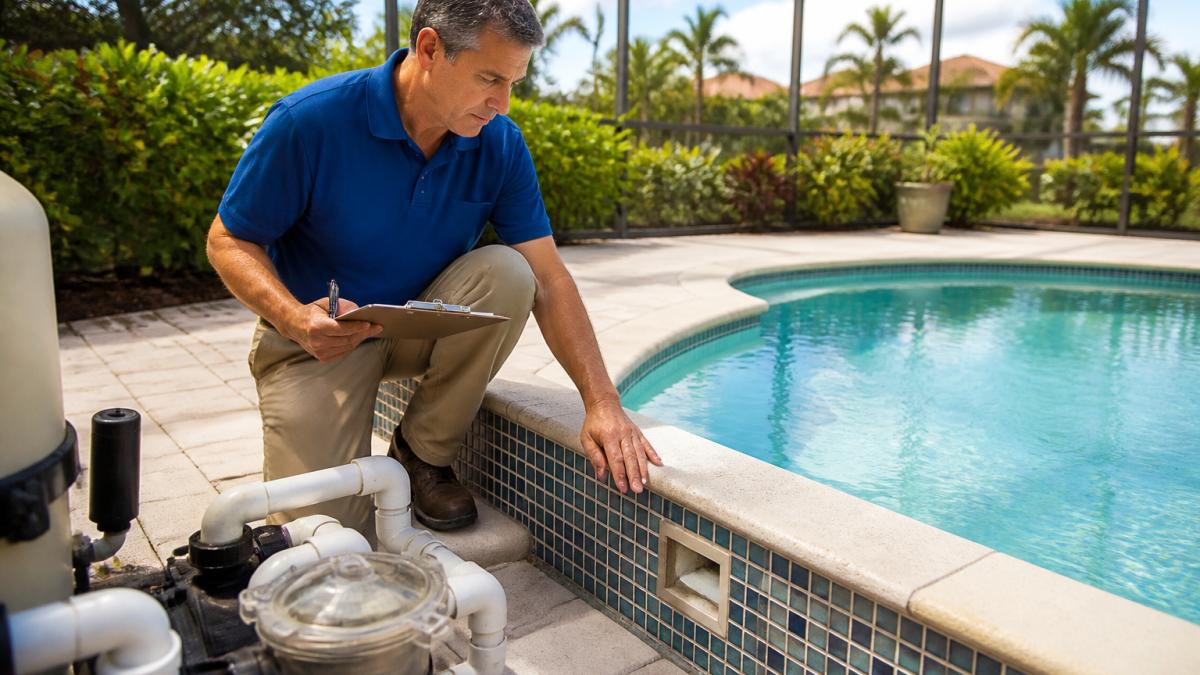
Inspect thoroughly before making an offer, a pool that looks fine on the surface may hide expensive problems.
Visual Condition Assessment
Start with what you can see. Walk around the pool and note the condition of:
- Tile or interior surface (cracks, discoloration, loose tiles)
- Deck and surrounding concrete (cracks, uneven surfaces, safety hazards)
- Water clarity (cloudy water suggests chemical imbalance or filter issues)
- Visible algae or debris (indicates maintenance neglect)
Check walls and floor for structural damage: cracks can indicate settling or age-related wear, and discoloration may signal leaks or chemical imbalances. A cracked deck is both a liability risk and an expensive fix.
Equipment and Safety Features
Examine the equipment area, most pools have a pump, filter, and chemical feeder. Ask the owner how old the pump and filter are, when the system was last serviced, and the annual maintenance cost. Rust, leaks, or corrosion signal aging systems; a new pump and filter can cost several thousand dollars.
Check for safety features:
- Drain covers (required by federal law) (Pool and Spa Drain Covers)
- Fencing around the pool (required in most areas) (the CDC)
- Gates with self-closing, self-latching mechanisms
- Rescue equipment visible (ring buoy, reaching pole)
Missing safety features must be installed before use, budget for them if absent.
Questions to Ask When Buying a Home With a Pool
Get answers to these questions before committing; the listing agent should provide them, or a home inspector can investigate.
Ask about repairs in the past five years, pump, filter, heater. Recent major repairs mean newer systems; old systems approaching failure are a red flag.
Ask about our savings programs and closing cost credits →
Ask for annual maintenance specifics, chemicals, equipment service, repairs, and any HOA fees, to budget for ownership.
Finally, ask about known issues, leaks, equipment problems, or structural concerns. Honest sellers disclose; hesitation is a warning sign.
Understanding Pool Maintenance Costs for Homeowners
Purchase price is only the entry ticket. The number that decides whether a pool home fits your budget is the all-in annual cost, which swings widely by pool type, equipment, enclosure, and maintenance. Here are the line items you can estimate before making an offer.
The line items that drive annual cost
| Cost line | What drives it | Typical annual range |
|---|---|---|
| Chemicals | Pool volume, salt vs. chlorine, usage, screen enclosure | $600-$2,400 |
| Professional service | Weekly vs. monthly, full-service vs. chemicals-only | $600-$3,000 |
| Electricity (pump) | Pump type, run hours, variable-speed vs. single-speed | $400-$1,200 |
| Heating | Heater type (electric, gas, heat pump), how often used | $0-$2,500+ |
| Water top-off | Evaporation, leaks, splash-out | $150-$600 |
| Repairs and reserves | Equipment age, surface condition | $300-$1,500 (averaged) |
| Insurance uplift | Liability exposure, safety features, carrier | $100-$500+ |
Treat these as planning ranges, not quotes. Get local bids from a pool service and an insurance agent before you close, the spread on each line can change your offer.
How pool type changes the math
- Chlorine vs. saltwater. Saltwater pools cost more up front for the salt cell but often run lower on chlorine purchases; the cell itself is a replaceable part with a multi-year lifespan, so ask its age.
- In-ground vs. above-ground. Above-ground pools are cheaper to remove and replace but shorter-lived; in-ground pools carry surface and structural costs that above-ground pools do not.
- Heated vs. unheated. A heater is the single biggest variable. Ask what type it is and how often the current owner runs it, heating can rival or exceed every other line combined.
- Screened enclosure vs. open. A screen enclosure cuts debris and chemical demand but adds its own repair and re-screening costs over time.
The equipment reserve most buyers forget
Pumps, filters, heaters, and salt cells fail on a schedule. Set aside a monthly reserve, budget one major equipment replacement every several years and divide by 12. Ask the seller for equipment ages and service records; recent replacements lower your reserve, aging equipment raises it.
Insurance and liability mechanics
A pool raises your homeowner's premium because it raises liability exposure. The levers that move the number:
- Safety features. Fencing, self-closing and self-latching gates, safety covers, and compliant drain covers can reduce both risk and premium. Ask your carrier which features they credit.
- Liability limits. Standard policies often carry limits that are low for a pool. Discuss raising limits or adding an umbrella policy with your agent.
- Exclusions and conditions. Some carriers require the pool be fenced or covered, or exclude injuries when safety rules are not met. Read the conditions, not just the premium.
- Permits and compliance. An unpermitted pool or enclosure can complicate both insurance and resale. Verify permits through the county before you commit.
Turn the estimate into an offer strategy
Use the cost breakdown as negotiating leverage. If equipment is near end of life or the surface needs work, get bids and factor them into your offer. A pool home priced like a turnkey property but carrying a pending equipment replacement is not the same value as one with recent updates.
Review Listing Photos and Property Details
When searching for how to find homes with a pool in port charlotte in Florida, listing photos tell a crucial story. Look for multiple pool photos from different angles, a single photo isn't enough. Good listings show:
- Overall pool view (size relative to yard)
- Deck and surrounding landscaping
- Water condition and clarity
- Equipment area
- Fencing and safety features
Read the property details carefully. The listing should specify pool size, pool type (in-ground, above-ground, saltwater, chlorine), year built or last renovated, heating system if applicable, and HOA fees if community pool.
Check the sales history. If the pool was recently added or renovated, that's a positive sign. If the home has been on the market multiple times, ask why.
Virtual tours often show pools better than static photos. Watch the video carefully for water condition, deck safety, and overall maintenance.
Get Expert Help Finding Your Pool Home
Searching for homes with a pool involves more than browsing listings.
At Savings Specialist Group, our team specializes in helping buyers find the right home in Southwest Florida, including Port Charlotte and Charlotte County.
A good agent answers pool questions honestly, knows which neighborhoods have the best pool homes, and can arrange inspections and pool specialists.
We also offer incentive programs and closing cost credits that can save you upwards of $20,000 on your transaction.
Ask your agent about comparable sales, recent prices for similar pool homes help you make competitive offers and understand fair pricing.
Frequently Asked Questions
How do I search for homes with a pool in Port Charlotte?
Use real estate listing sites and filter by amenities, select 'swimming pool' or 'pool' in the search filters. Narrow results by location (Port Charlotte, ZIP code 33948), property type (single-family home), and price range. Review listing photos and property details to confirm pool type: private, built-in, heated, or community access. Many sites let you save searches and receive alerts when new homes with pools match your criteria.
What should I check when viewing a home with a pool in Port Charlotte?
Inspect the pool structure for cracks, staining, or algae. Check equipment (pump, filter, heater) for age and condition. Verify fencing meets local safety codes. Ask about maintenance records and recent repairs. Look for proper drainage and chemical balance. If the pool is screened or enclosed, inspect the enclosure frame for damage. Consider hiring a professional pool inspector before making an offer to identify costly repairs you might inherit.
What extra costs should I budget for when buying a home with a pool?
Plan for monthly maintenance ($100-$300), chemicals ($50-$150 monthly), equipment repairs and replacement ($500-$2,000 annually), and higher homeowners insurance ($200-$500 extra yearly). Heated pools add utility costs. Expect one major repair every 5-10 years (pump, filter, resurfacing: $3,000-$15,000). Factor in drain cleaning, tile repair, and deck maintenance. Ask the seller for maintenance records and recent service invoices to estimate actual costs for that specific property.
Should I get a separate pool inspection when buying a home with a pool?
Yes. A standard home inspection may not thoroughly evaluate pool condition. A certified pool inspector examines structural integrity, equipment, plumbing, electrical systems, safety features, and compliance with local codes. This costs $300-$600 but can reveal hidden problems, cracked shells, failing pumps, or code violations, that could cost thousands to repair. It's especially important for older pools or if the seller cannot provide maintenance records.